
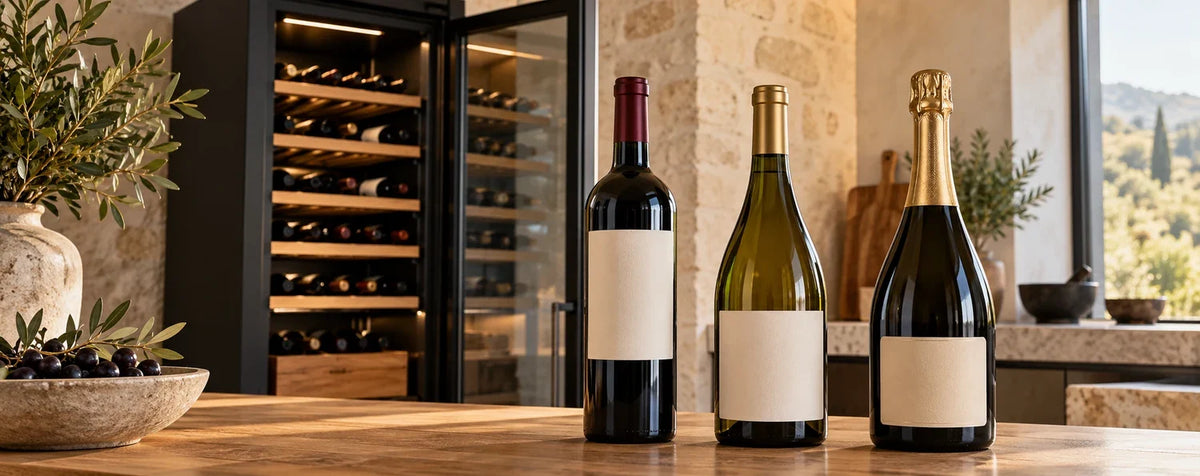
Choosing a wine cooler starts with the number of bottles you want to store. But one detail matters: bottles with the same volume can have different shapes and take up different amounts of space. Knowing the reference bottle and loading plan helps you choose a suitable capacity for your collection.
What does advertised capacity mean?
Bottle capacity indicates how many bottles fit under the reference conditions defined for the model. Many wine coolers use 75 cl Bordeaux bottles and a specific arrangement of shelves and bottles for this calculation.
Do not assume the advertised number applies to every bottle shape. Check the technical specifications, capacity notes and manufacturer’s loading plan to understand the conditions used.
Establish whether the figure applies with all supplied shelves installed, with an approved stacking configuration or with another permitted layout. The rules vary between brands and models.
Why can actual capacity be different?
A collection may include narrow bottles, bottles with sloping shoulders, wider sparkling wine bottles and special formats. Even when they all hold 75 cl, width, length and shape can change the space required.
Capacity in everyday use combines:
- Bottle shape: diameter, length, shoulders and base.
- Shelf configuration: number of shelves, available height and compatibility.
- Permitted arrangement: a single layer, stacking or display positions where the model allows them.
- Bottle access: a more accessible layout may differ from the maximum-capacity configuration.
- Distribution between zones: space is divided in appliances with several compartments.
There is no universal percentage reduction for all wine coolers. Confirm capacity using your bottles and the specific appliance.
The main bottle shapes to consider
Bordeaux bottles
These typically have a relatively straight body and pronounced shoulders. They are a common reference for capacity calculations, but not all Bordeaux bottles have identical dimensions.
Burgundy bottles
These have sloping shoulders and often a wider body. They may need more space between bottles or shelves. Check capacity against the model’s loading plan.
Sparkling wine bottles
Many sparkling wine bottles are wider and sturdier. Some coolers offer shelves or configurations specifically for these formats. Space for one bottle does not guarantee the advertised capacity for a collection made up mainly of sparkling wines.
Tall bottles and special formats
Long, slender bottles may need more usable depth, while magnums and other large formats require suitable supports and space. Volume in litres is not enough: check external bottle dimensions and shelf limits.
Portuguese producers use different bottle shapes for wines from the Douro, Dão, Alentejo, Vinho Verde and other regions. A wine’s origin or colour alone does not tell you its bottle shape.

How shelving affects capacity
Storage shelves
Some models allow bottles to be stacked following the manufacturer’s loading plan. This can make better use of the space, but must respect stability requirements and the stated maximum load.
Sliding shelves
Sliding shelves make bottles easier to reach and the collection easier to organise. Space for mechanisms and clearance between levels can influence capacity, depending on the appliance’s construction.
This does not mean every cooler with sliding shelves has a lower capacity. Compare the permitted configurations of the model you are considering.
Display shelves
Angled bottles that show their labels may take up a different amount of space from horizontal storage. This is useful for showcasing wines, but confirm the capacity for that configuration.
Removing or adding shelves
Some appliances allow changes to shelf position or number. In others, certain elements must remain installed. Never remove a shelf to force a bottle to fit without checking whether the change is permitted.
Adding a shelf does not guarantee room for more bottles. It may improve access while reducing stacking height. Use only accessories compatible with the model.
How to choose capacity for your collection
- Count the bottles you want to store. Distinguish your usual stock from occasional purchases.
- Identify the main shapes. Keep a representative bottle of each type to hand, with its measurements.
- Consider how you use the collection. Do you want individual access or are you happy with an approved storage arrangement?
- Check the appliance configuration. Review capacity with the supplied shelves and the loading plan.
- Allow for future purchases. Choose headroom that suits your habits rather than applying a universal percentage.
- Check the installation space. Confirm dimensions, ventilation and door clearance before proceeding.
For example, if your mixed collection contains many wide bottles, do not choose on the advertised total alone. Ask for the loading configuration and check that the appliance accommodates both the shapes and accessibility you need.
Complete your selection with our tips for choosing a wine cooler.
Total capacity and capacity per zone
In a dual-zone cooler, total capacity is the sum of the compartments. They may have different capacities, and shelves cannot always be moved freely between them.
If you want many sparkling wines in the cooler zone, check that zone’s capacity for your bottles rather than only the appliance’s total.
Zone count is a choice linked to use. Read single or dual-zone wine cooler: which should you choose? to understand the difference.
Mistakes to avoid when arranging bottles
- Forcing the door shut: bottles must not press against the glass or prevent proper closure.
- Exceeding shelf loads: follow the limits and arrangement in the manual.
- Blocking airflow: keep the areas specified by the manufacturer clear.
- Stacking without approval: not every shelf is designed for multiple layers.
- Using incompatible accessories: always confirm the shelf or support reference.
- Ignoring door clearance: check that the opening allows shelves to be withdrawn without obstruction.
Good organisation should keep bottles safe, maintain the intended operation and make it easy to find the wine you want to open.
Frequently asked questions about wine cooler capacity
Does a cooler advertised for 50 bottles always hold 50?
Not necessarily. The figure depends on the manufacturer’s reference bottle and configuration. A collection with different bottle shapes may take up more space.
Do all 75 cl bottles take up the same space?
No. Wine volume does not determine external dimensions. Two 75 cl bottles can have different diameters and lengths.
Can I store sparkling wine in a normal wine cooler?
It may be possible if bottles fit in approved positions, the temperature is suitable and the model’s limits are respected. Advertised capacity may decrease.
How much does capacity decrease with Burgundy bottles?
There is no universal reduction. It depends on bottle dimensions, internal width, shelves and the appliance’s loading arrangement.
Does removing shelves allow more bottles?
In some models, an approved configuration allows stacking or larger bottles. In others, removing shelves is not permitted or does not improve capacity. Check the manual.
Can I store magnums?
Only if the internal space, supports and permitted load are compatible. Confirm the specific format rather than assuming compatibility from the total advertised bottle count.
How can I confirm capacity before buying?
Check the specifications and loading plan. For a mixed collection, tell our team the dimensions and approximate proportion of each bottle type so we can assess the model’s configuration.
Choose space for the bottles you actually keep
The right capacity combines quantity, shapes and organisation. A cooler that suits your collection lets you store wine safely and enjoy it conveniently.
At cavesdevinho.pt, explore wine coolers in different capacities. For wider, taller or special bottles, speak to us before buying to confirm the available information about the model.
Every bottle deserves its place, from the first purchase to your next toast.
Technical references
Manufacturers explain how shapes and layouts affect capacity: see the La Sommelière FAQs and mQuvée FAQs. One brand’s reference conditions should not automatically be applied to another. The model’s loading plan is the reference for interior organisation.


